
Type the name of the breed you're looking for below
[wpdreams_ajaxsearchlite] Don't see the breed your're looking for? Click here and let us know!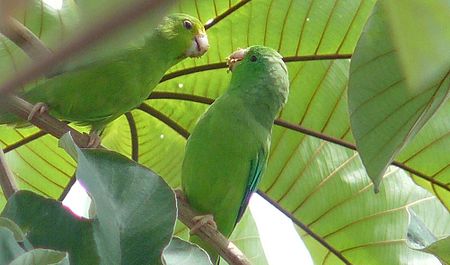
[fbcomments]
Green Rumped Parrotlet
| Origin | It is a resident breeding bird in tropical South America, from Caribbean regions of Colombia, Venezuela and Trinidad south and east to the Guianas and Brazil, on the downstream Amazon River. It has been introduced in Jamaica, Curaçao, Barbados and Tobago, and was not recorded on Trinidad prior to 1916. |
| Size | This species can grow up to 5 in(13 cm) |
| Lifespan | Can live 10+ years |
| Noise | High |
| Characteristics | Green-rumped parrotlets exhibit sexual dimorphism. Both sexes are primarily bright green with short tails and a pinkish beak. Males have a brilliant blue wing patch; females lack blue but have some yellow on the head. |
| Abilities | Can learn to say a few words over time. |
| Interaction/Time Requirements, Diet, Supplies Needed | They don't like to be in crowded spaces and will sometimes be aggressive towards other birds if they don't have enough space. A large cage is required even if the bird is going to spend lots of time out of its habitat with you. They require a warm habitat for the winter months. Do not allow your birds outdoors until all signs of frost are gone. Space is important and indoor cages should be as large as possible. Their diet in the wild consists of mainly fruits, wild figs, unripe nuts, flower and leaf buds, and some seeds. In captivity, they will eat most fruits including mangos, figs, guavas, bananas, melons, stone fruits, grapes, citrus fruits, pears, apples, pomegranate and papaya (pawpaw). You need to change food and water daily, and clean the cage at least once a week, replacing toys and broken climbing branches. Parrots do well in aviaries and cages. |
| Other Considerations | Parrotlets can also be hand reared, provided that they have a large cage and are taken out of their cage on a daily basis to prevent boredom, as it may result in the parrot pulling out its feathers to occupy itself. |